 Early signs are not triggers
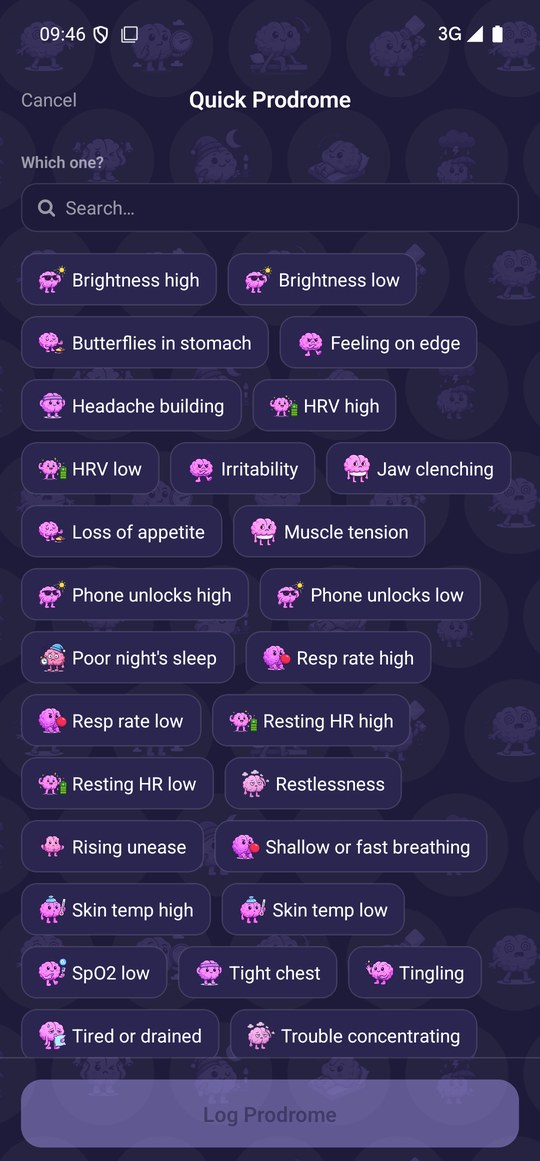
A trigger is something that happened to you: a long walk, a big dinner. An early sign is something happening in you: the joint that is warm the evening before, the night you could not settle. The app keeps the two lists apart so the comparison stays honest, and both count towards your risk. The wizard page is called early signs; in Quick Log the tile says Prodrome, the clinical word.
 From your wearable, every morning
Skin temperature, resting heart rate, HRV, respiratory rate and SpO2 come from Garmin, Oura, Polar or WHOOP directly, or from Apple Health and Health Connect. Each morning the app compares the night's value with your own 14-day baseline and a fixed line, and notes an early sign when it crosses. The app reads these numbers; it does not measure them, and a raised reading is a threshold crossing, not a diagnosis.
 Tested like everything else
What Happened in Insights compares each early sign with your flare days the same way as a trigger, so you find out whether a twinge or a warm night actually went before your flares, or whether it did not. A link is not a cause, and the app says so on the screen.
Setup asks once
During setup you tick the changes you tend to notice before a flare. Those become favourites in Quick Log, with the weight you gave them. You can change any of it later in Manage Items.
Where it lives in the app
The Prodrome tile in Quick Log and the early signs page of the flare log for the ones you notice. Monitor and then Physical Health for skin temperature, HRV, resting heart rate, respiratory rate and SpO2, and Mental for unlocks, brightness and volume. What Happened in Insights for how each compared with your flares.
What it needs from you
A tap for the ones you feel. A connected wearable, Apple Health or Health Connect for the body ones; the app reads them, it does not measure them. The phone ones need no permission beyond the app itself on iPhone, and usage access on Android for unlocks.